

Kraken and Coinbase officially added perpetual futures to their arsenal.
Decentralized exchanges are processing over $1 trillion in perp volume monthly, according to the latest CoinGecko’s State of Crypto Perpetuals Report 2026.

Kraken and Coinbase officially added perpetual futures to their arsenal.
Decentralized exchanges are processing over $1 trillion in perp volume monthly, according to the latest CoinGecko’s State of Crypto Perpetuals Report 2026.
And somewhere in the middle, the line between structured trading and pure speculation keeps shifting.
Perps aren't new, but the conversation around them gets louder than ever.
Here we break down how perpetual contracts work and how they differ from standard futures and margin trading. We will also cover the mechanics of funding rates, and contrast of how TradFi leaders and crypto experts from ChangeNOW view this growing market.
A perpetual future (or perp for short) is a contract on the price difference of an asset, but not on the asset itself.
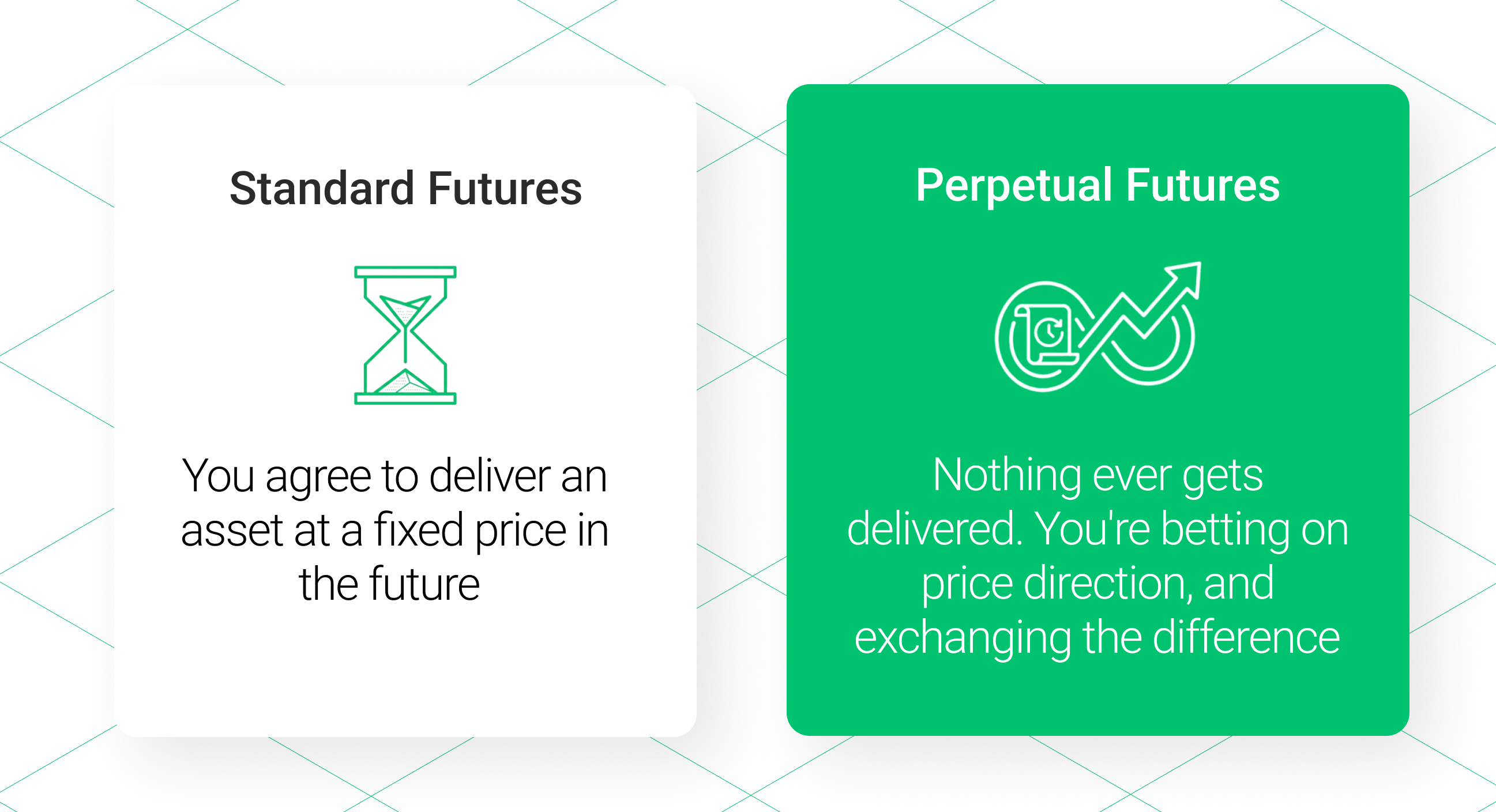 Let’s say you and your friend bet on Bitcoin's price. You think it's going down (you short), your friend thinks it's going up (they long).
Every 8 hours, as long as the bet stays open, one of you pays the other a small amount. That payment is called the funding rate.
If most of the market shares your friend's sentiment, longs (including him) pay shorts to keep the perp price tied to spot. If the majority are bearish like you, shorts pay instead.
Without the funding rate, the perp's price could drift too far from the actual spot price, and the contract would stop reflecting reality. That would let arbitrage traders go wild.
As ChangeNOW’s Chief Product Officer Elias Vilochkin explains it:
"Perps definitely have distinct mechanics. No expiry, the ongoing funding mechanism, historically higher leverage, and a market that never sleeps. Combined, it creates an environment where drawdowns can accumulate faster and completely under the radar."
For that matter, perps often get compared to margin trading. They share the same high-risk, high-reward profile, but that's about it.
Margin trading is a whole different story: you're borrowing real funds against a real asset, and paying interest on the loan.
Here are same three instruments, side by side comparison:
| Feature | Perps | Traditional Futures | Margin Trading |
|---|---|---|---|
| Expiration | None | Fixed date | None |
| What you're trading | A contract | A contract | The actual asset |
| Leverage source | Protocol collateral | Exchange | Borrowed funds |
| Price anchor | Funding rate | Settlement date | Spot price |
| Cost of holding | Funding fees | Priced into contract | Borrowing interest |
Since perps never expire, they have a mechanism to keep their price from drifting away from the actual spot market. It’s the funding rate we were talking about earlier and it’s essentially a financial tether.
The funding rate isn't a fee paid to the exchange. It’s a P2P rebalancing mechanism that happens directly between traders.
The real trap is that funding fees feel invisible because they are debited directly from your margin balance - you don’t even need to close out. It’s incredibly easy to treat a perp position like a spot bag that you can just sit on for months.
And of course, there’s a catch: the funding rate applies to your full position size, not just your collateral.
Say you put up $1,000 and use 10x leverage. You're now managing a $10,000 position. A "tiny" 0.05% funding rate isn't nibbling at $10,000, it's coming straight out of your $1,000. Leverage just made that fee hit ten times harder.
Stay in a high-funding position for too long, and it will quietly eat your profits or trigger a liquidation while the price barely moves.
The other trap is more psychological in nature and we’re covering it in the next section.
Switching from spot or margin to perps completely changes the daily trading routine. It’s a mix of different mechanics and a subtle shift in trading psychology.
With classic margin trading as we know it, you’re physically borrowing coins from a lending pool. And it leaves you exposed to sudden interest rate spikes and liquidity bottlenecks. Perps are purely synthetic by nature: you aren't actually borrowing anything, which is why dialing your leverage up or down is so fast and friction-free.
But while crypto-native platforms celebrate this capital efficiency, TradFi icons look at the exact same mechanics with deep skepticism.
Speaking on CNBC, CME Group CEO Terry Duffy didn’t mince words, comparing the current retail perp boom to the subprime mortgage crisis: "This is 2007 for retail."
Duffy points out that the built-in auto-liquidation engines of perps can easily trip over each other during high volatility, causing exponential, cascading crashes. He also criticizes the core mechanics of the contracts, specifically, the lack of an expiration date:
"Because a perpetual does not expire... you cannot forward hedge that product with any credibility of a future data delivery or cash settlement. So it’s not a credible product. It’s a leverage product. That’s all it is."
Ultimately, the lack of an expiration date limits a perp’s utility for traditional hedging, making it strictly an instrument for leverage. And this highlights the core structural difference: TradFi derivatives are typically designed for risk management, while crypto perpetuals are optimized for capital exposure.
But it’s not like crypto exchanges are blind to this weak spot.
To avoid unnecessary liquidations during local flash crashes, platforms now use a Mark Price - a smoothed index that is tied to global spot markets, protecting positions from sudden price spikes on a single exchange.
That technical flexibility is great, but losing the expiration date removes a major psychological guardrail.
On Reddit a trader highlighted exactly how this flexibility backfires: without a forced settlement date, you lose the natural checkpoints that make you step back and re-evaluate.
A quick, short-term idea easily blurs into an unplanned, indefinite hold. When the price moves against you, it’s dangerously easy to keep adding margin to a losing trade just to "buy time" and avoid admitting the thesis didn't work out. It also might get expensive because you aren't just sitting in a losing position, you are actively paying a funding rate simply to delay a decision.
A 2025 review in Psychology Today points to a structural reason for this: features like instant mobile access, zero fees, and gamified interfaces make modern trading platforms feel less like investing and more like betting, regardless of the asset being traded.
Perps amplify that dynamic. No expiry date and a recurring funding rate remove the natural pauses other instruments build in by default.
ChangeNOW’s Head of Brand and public speaker, Pauline Shangett notes that this behavioral shift is exactly where the risk lies, rather than in the tool itself:
"Perps are an interesting evolution, but they require a high level of self-control. Because they are so seamless, it’s incredibly easy to slip into a mindset of pure speculation and blow through your capital. They offer way more flexibility than traditional futures, but that comfort can make traders complacent, blurring the line between a structured strategy and a game of chance. There’s no point in demonizing perps. They are a legitimate trading tool used actively across the market. But you have to remember that all this flexibility comes with a very specific set of challenges."
For years, perpetual futures were primarily the domain of offshore, lightly regulated platforms.
The entry of US-native giants like Coinbase and Kraken into the scene marks a structural shift. It pushes the instrument from the shadows of crypto speculation straight into the regulated mainstream.
What changes with Kraken and Coinbase entering the market:
Perps are losing their "wild west" reputation and becoming a normal part of finance.
But regulators are still arguing over whether this mainstream adoption happened too fast. Won’t it bring more chaos to the market?
ChangeNOW's CPO Elias Vilochkin sees it this way:
"It depends on the horizon you're looking at. Cascading liquidations and market manipulation can definitely create short-term chaos. But overall, the democratization of tech and financial tools is a net positive in the long run. Bans and heavy-handed regulation are quick political wins that patch isolated risks. Over the long term, letting the market learn and accumulate experience brings far more benefits to everyone."
The debate keeps splitting along the same line. Traditional finance sees a high-leverage product without the guardrails derivatives are supposed to have. Crypto sees a flexible tool that finally matches how the market actually trades - non-stop.
The mechanics are not what makes perps risky or safe, it’s how someone trades them.
Coming back to where we started, as Elias frames it:
"Gambling is when the outcome is dictated by pure chance. Perps don't change the core reality of trading: you still need a thesis, you still analyze the data, and you still manage the position. High risk doesn't mean it's a game of chance, otherwise, venture capital would be in the same boat. People criticized margin trading for the exact same reasons early on, but the market digested it just fine. It will digest perps, too."

Crypto Winter Survival Guide: What Support Teams See During Market Crashes
Real stories from ChangeNOW support about delayed payouts, transaction mistakes and what users experience during periods of market uncertainty.

Is Crypto Halal or Haram? Bitcoin, Trading and Staking in Islam
Is crypto halal or haram depends on how it is used. Different activities such as buying Bitcoin, staking, or leverage trading are viewed separately under Islamic finance. Ownership, risk, and speculation determine why some cases are considered acceptable and others are questioned.

How to Choose the Right Crypto Wallet
Discover 2026 guide to choosing the right crypto wallet | From hot vs cold storage to custodial vs non-custodial options | Keep your crypto safe with security tips


