Real-World Assets (RWA) are simultaneously crypto’s most discussed narrative and its most under-exploited infrastructure play. From tokenized treasuries to digital trade finance, real value is emerging only where networks deliver real utility – and that’s precisely where IOTA steps up.
Global supply chains are not niche verticals. In 2025, international trade in goods and services exceeded $35 trillion, representing roughly one third of global GDP. Despite the scale, much of global trade still runs on paper, siloed databases, manual verification, and delayed reconciliation:
This is not a blockchain-native market looking for yield. It is a $35 trillion analog system in need of digital infrastructure.
IOTA redefines how trade data, identities, and asset ownership interoperate digitally. Instead of layering speculation on top of finance, it anchors real-world documentation, identity, and asset flows directly onto public infrastructure.
The RWA Opportunity in Trade and Supply Chains
Tokenizing trade flows is not about inventing new assets. It is about upgrading the ones that already exist:
Bills of lading, invoices, warehouse receipts, and certificates become cryptographically verifiable records.
Physical commodities become digitally represented and auditable on-chain assets.
Receivables and trade documents become collateralizable, transferable RWAs, unlocking liquidity.
RWA tokenization in trade is not theoretical DeFi. It is about reducing settlement friction, cutting compliance costs, and transforming paper-based claims into programmable capital.
and verifiable credentials create a global trust layer. Any participant owns and controls their identity – crucial in regulated, cross-border trade.
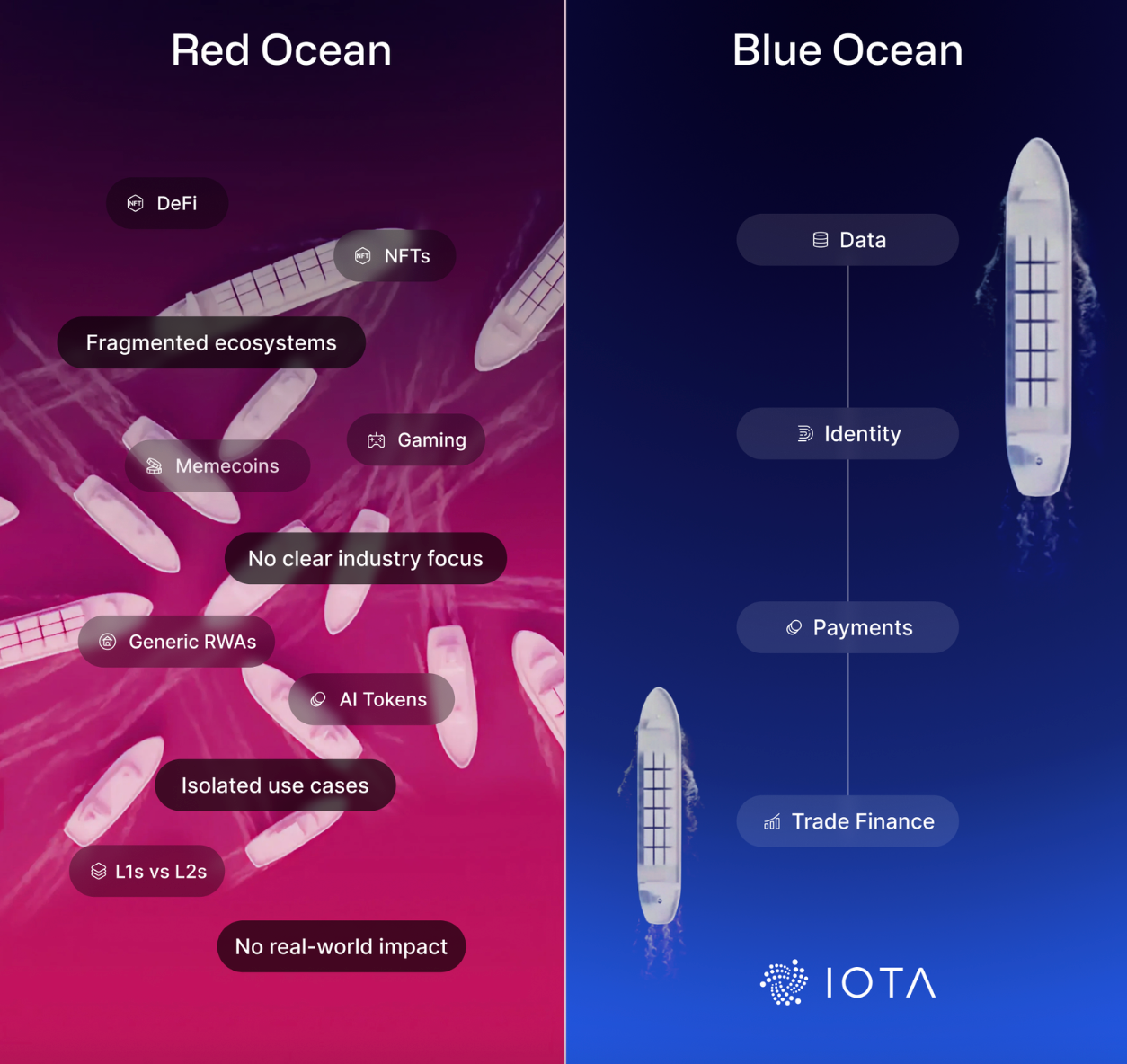
IOTA’s vision of on-chain global trade market – Blue Ocean strategy
A Blue Ocean strategy creates new, uncontested markets where competition becomes irrelevant, while Red Ocean strategies fight for marginal advantages inside crowded, mature sectors.
Even a modest 5% efficiency gain in global trade would unlock hundreds of billions of dollars in economic value, given that annual trade flows exceed $35 trillion. In a market of this size, efficiency is a macroeconomic leverage.
According to the
World Economic Forum
, trade digitalization initiatives have the potential to reduce global trade costs by up to 25%, while expanding access to financing and lowering entry barriers for emerging markets. The demand for scalable digital trade infrastructure is therefore structural, not speculative.
IOTA’s strategy is not to compete in saturated DeFi or token issuance markets. Instead, it focuses on:
digitazing trade documentation
enabling verifiable identities
transforming static trade flows into programmable infrastructure.
Since 2018, the IOTA Foundation has been building in global trade and supply chains, progressively scaling its investment and institutional partnerships. TWIN represents a structurally different approach – open, interoperable, and built around shared standards rather than centralized control.
IOTA’s vision is not rhetoric – it reflects years of infrastructure development. As Dominik Schiener, Co-Founder and Chair of the IOTA Foundation, writes in
the 2026 IOTA Manifesto
:
“Over the last few years we have created the solutions, products, and partnerships to deeply embed IOTA into the entire trade sector, from tracking shipments and digitizing paperwork, issuing digital identities and verifiable credentials, to tokenizing physical assets and powering trade finance.”
This broader vision is further outlined in IOTA’s trade-focused presentations:
This is RealFi. Powered by IOTA.
TWIN: The Backbone of Tokenized Trade Infrastructure
At the forefront of IOTA’s RWA narrative is
TWIN (Trade Worldwide Information Network)
– not a pilot, but real open-source trade infrastructure. It’s designed as a modular, decentralized system that unifies how data, assets, and credentials flow in global commerce.
What TWIN does:
1. Connected, Decentralized Trade Data
TWIN enables secure, verifiable exchange of trade information across borders and participants without central gatekeepers. Governments, logistics providers, customs offices, and exporters can all interact within a trusted framework.
2. Standards-Aligned Open Architecture
Built with open APIs and aligned with global standards like Gaia-X and emerging dataspace protocols, TWIN prevents vendor lock-in and encourages interoperability across digital ecosystems.
Early implementations – for example in
Kenya’s export networks
and
UK-EU customs pilots
– show real reductions in friction, faster processing, and rich traceability that’s auditable and tamper-proof.
5. Foundation for Tokenized RWA
Beyond documents, TWIN makes it possible to tokenize trade assets directly – from commodity certificates to supply-chain receivables – and bring them into programmable finance.
This isn’t just tech for tech’s sake: it aims to cut trade costs, improve speed and transparency, and build a neutral digital public good infrastructure for international commerce.
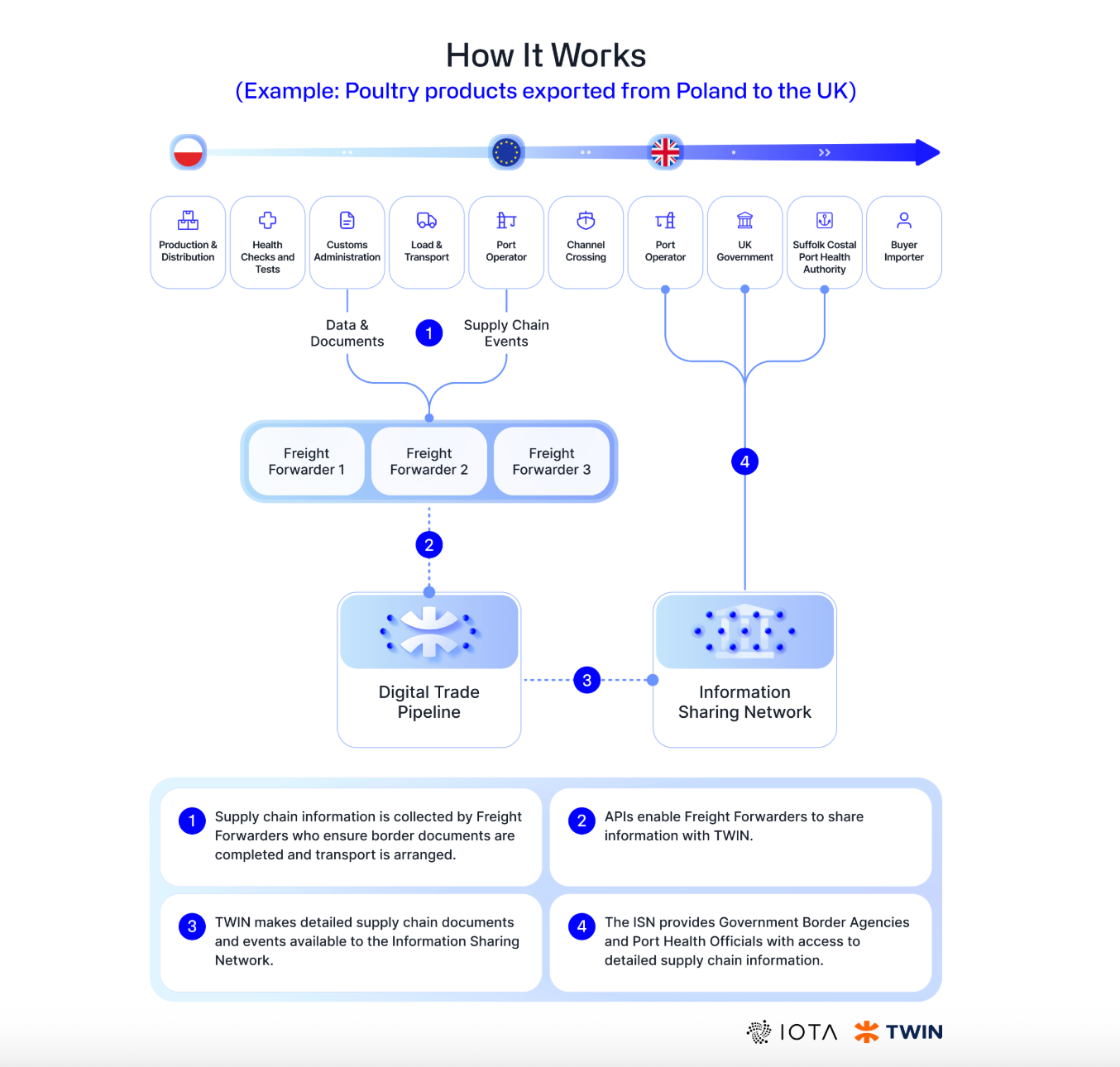
How TWIN Enables Tokenized Trade: A Real-World Flow
Step 1 – Exporter Issues Digital Trade Document
Exporters upload a bill of lading or certificate of origin into TWIN’s system.
⬇
Step 2 – Document Becomes a Verifiable Credential
The document is cryptographically signed and converted into a verifiable credential tied to the exporter’s decentralized identity (DID).
⬇
Step 3 – Event Is Anchored on IOTA
A hash of the document and its status is anchored on IOTA’s public ledger, creating an immutable timestamp and proof of authenticity without exposing sensitive data on-chain.
⬇
Step 4 – Instant Cross-Border Verification
Importers, customs authorities, or banks can instantly verify the document’s validity without relying on email chains, paper copies, or manual confirmation.
⬇
Step 5 – Receivable Becomes Collateralizable
Once the shipment is verified and status-confirmed, the receivable tied to that shipment becomes a trusted, auditable financial claim.
⬇
Step 6 – Trade Asset Can Be Tokenized
The verified receivable can be tokenized as a real-world asset (RWA), enabling financing, transfer, or integration into DeFi and institutional liquidity pools.
How This Ties to RWA Tokenization
Tokenization only works if the underlying data is trusted, verifiable, and universally accessible. TWIN:
Turns physical/legal trade documents into digitally trackable assets.
Anchors trade events and statuses immutably on IOTA’s ledger.
Wraps ownership proof into transferrable tokens that can integrate with DeFi and RWA protocols.
This is the precise intersection between supply-chain logistics and RWA financialization. By enabling tokenized trade flows, TWIN makes assets that used to sit in Excel sheets tradable on chain – creating bridges between traditional commerce and decentralized finance.
The most elegant ecosystems fail if users can’t participate. That’s where access layers like ChangeNOW come in.
We remove barriers to entry into IOTA’s world of tokenized RWA:
Instant swaps from hundreds of assets into IOTA tokens.
Liquidity routing for users to enter or exit positions quickly, including exposure to emerging RWA tokens.
Cross-chain bridges that help traders diversify into related RWA ecosystems beyond IOTA (like Ethereum or Avalanche based tokenized assets).
The Broader RWA Landscape
While IOTA and TWIN focus on trade flows and data infrastructure, the RWA narrative spans multiple sectors:
Tokenized treasuries and money markets
Commodities and metals represented on specialized protocols
Institutional RWA pipelines emerging on permissioned and public ledgers
ChangeNOW makes all of that accessible, allowing users to redistribute capital across the RWA spectrum while keeping IOTA at the center of supply-chain digitalization.
Global trade is a $30+ trillion problem set – and it’s finally seeing modern infrastructure built for the digital age. IOTA’s architecture, paired with TWIN’s open, interoperable infrastructure, isn’t theoretical. It’s rolling out in real jurisdictions and already transforming how goods, data, and value flow internationally.
Ethereum’s network activity is hitting ATHs, yet its token price recently collapsed to a multi-year low. Is this a temporary market shakeout ahead of the next major upgrade, or is ETH's economic model fundamentally broken?
TON vs GRAM vs Toncoin: Same, But Different, But Same?
Toncoin is becoming GRAM. And no, you don't need to do anything. Here's what's actually changing, what isn't, and how ChangeNOW is handling the transition.
Most crypto projects added an AI narrative after the market decided AI was the next big thing. NEAR Protocol had founders with machine learning backgrounds years before that trend existed.