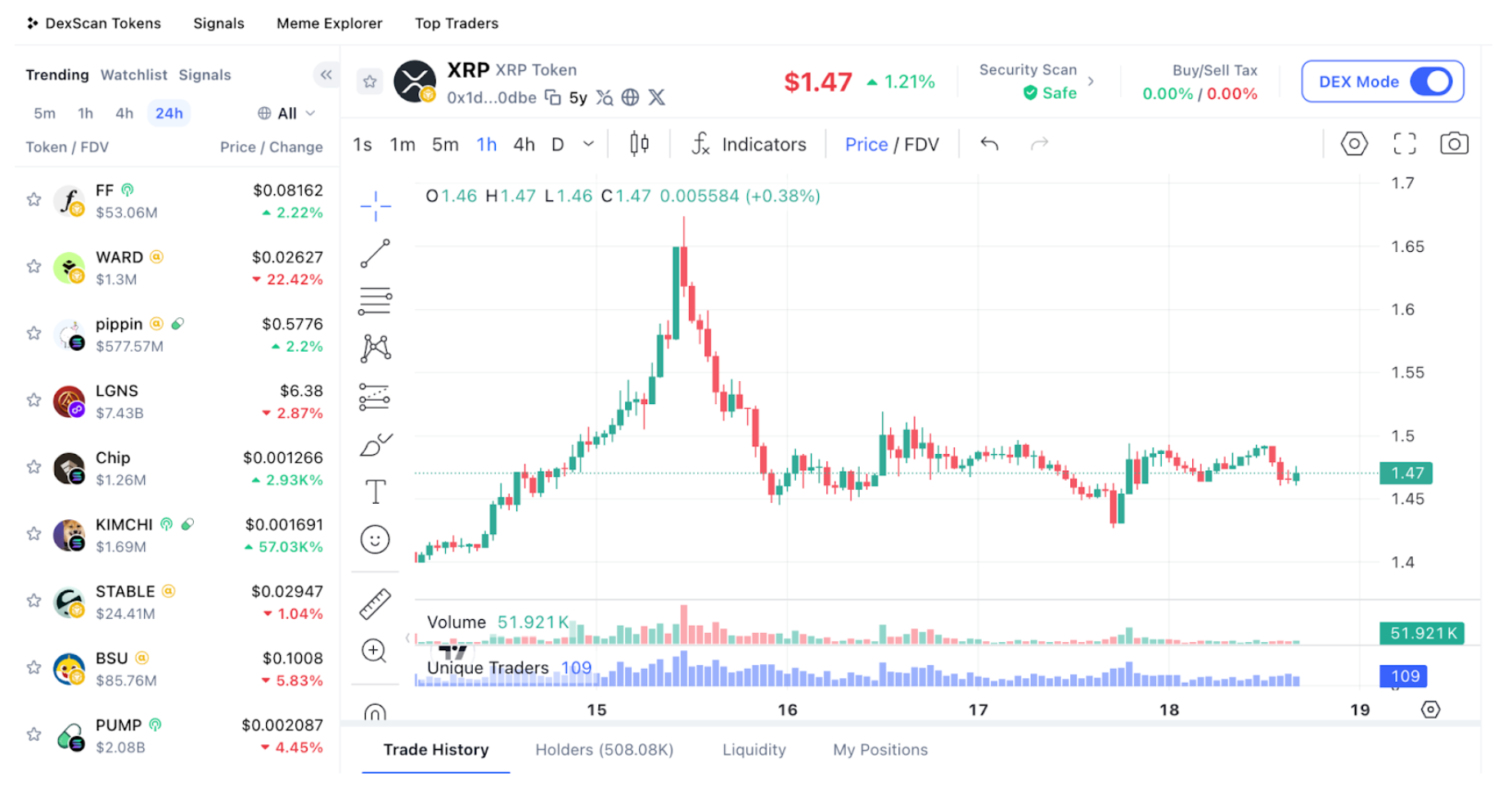
A realistic XRP forecast starts with an uncomfortable truth: price targets mean nothing without the conditions that make them possible.
You can write “$10 by 2030” in one line. The hard part is explaining how XRP would attract enough capital to get there, why that capital would stay, and what would have to change in adoption and market access for the move to hold.
This article treats XRP as what it is in practice: a liquid, heavily traded asset that can spike hard in risk-on cycles, but also an infrastructure token with adoption constraints that do not disappear just because the market is bullish.
XRP Price Scenarios 2026–2035
These ranges are designed as potential year-end outcomes. Intrayear spikes can be higher, but sustaining a level requires persistent liquidity and participation.
Instead of predicting a single price, it is more useful to map out ranges based on different market conditions.
These scenarios reflect how XRP could behave depending on liquidity, adoption, and market access.
Important Note on Forecast Ranges
Intrayear peaks can exceed these ranges during high-liquidity phases. The ranges focus on levels that can hold into year-end based on market depth, access, and demand persistence.
Forecast Table
Year
Bear
Base
Bull
What dominates that year
2026
0.8–1.5
1.7–2.5
3.0–4.5
cycle positioning and liquidity
2027
0.6–1.2
1.5–2.3
2.5–4.0
post-peak digestion
2028
1.0–2.0
2.5–4.5
5.0–8.0
base building
2029
0.8–1.5
2.0–3.5
4.0–7.0
pullback risk
2030
1.0–2.0
3.0–6.0
6.0–10.0
adoption visibility test
2031
1.5–2.5
4.0–7.0
8.0–12.0
scaling and resilience
2032
2.0–3.5
5.0–9.0
10.0–18.0
broad liquidity expansion
2033
2.0–3.0
5.0–8.0
9.0–15.0
regime stability
FAQ
Base scenario is $1.7–2.5. The range widens if the market is in a late-cycle phase.
Yes, but it requires a valuation scale comparable to the largest networks, which implies deep liquidity and durable demand, not just a single altseason.
Because the uncertain part is not “price volatility.” The uncertain part is whether adoption becomes structural or remains narrative-driven.
No. It creates a predictable upper limit on monthly supply release, which reduces uncertainty. But market reactions to unlock headlines can still affect sentiment.
Fast settlement and low minimum fees are core. The built-in DEX and tokenization features add utility, but adoption is still decided by institutions and liquidity.
2034
3.0–5.0
7.0–12.0
15.0–25.0
structural demand
2035
4.0–6.0
8.0–15.0
20.0–40.0
market share outcome
Looking at long-term price history helps put these scenarios into context.
XRP has repeatedly moved in sharp cycles, with strong rallies followed by extended consolidation periods. Price expansion usually depends on liquidity entering the market, while drawdowns often happen when that liquidity fades.
This behavior is consistent with a liquidity-driven asset, where price does not move in a straight line but in cycles tied to market conditions.
These ranges overlap because market conditions rarely align cleanly. A base scenario can look bullish in a hot cycle and bearish in a cold one. The difference is what happens after the excitement fades.
How This XRP Price Prediction Was Built
This forecast is not based on a single model or technical indicator.
Instead, it combines market structure, historical behavior, and capital flow constraints.
The goal is not to guess exact prices, but to define realistic ranges under different conditions.
The model is built on four core components:
1. Market Cycle Behavior
XRP has historically moved in sharp cycles, with strong rallies followed by long consolidation phases.
The forecast assumes that this cyclical structure continues, with expansion phases driven by liquidity and contraction phases driven by capital outflows.
2. Market Cap Constraints
Every price level implies a specific market capitalization.
The year-by-year ranges are anchored to a simple logic. Market cycles define when expansion or contraction is likely. Market cap constraints define what price levels are realistically achievable at each stage. Liquidity and market access determine how far price can extend without breaking, while adoption decides whether gains can hold or fade.
The ranges in this forecast are not fixed predictions. They are conditional outcomes based on how these variables align over time.
XRP Market Snapshot
Before projecting long-term price scenarios, it helps to anchor expectations in current scale. According to CoinMarketCap, XRP’s market metrics fluctuate over time, but the framework below shows how scale, supply, and capital flows connect to long-term price ranges.
The numbers below reflect XRP’s current market scale. This matters because price targets are not abstract. They are a function of capital inflows relative to supply.
The values below are indicative and used to illustrate scale. Exact metrics change over time.
Metric
Value
Price
~$1.46
Market cap
~$89B
24h volume
~$2.29B
Total supply
~99.98B XRP
Circulating supply
~60.91B XRP
Fully diluted valuation
~$146B
These metrics are not static. They change with market conditions, and even small shifts in participation can significantly impact price behavior.
Why this matters: a move from ~$1.5 to $10 is not “just a rally.” It implies a market cap shift into the hundreds of billions. That requires a different level of liquidity and participation than a normal altcoin pump.
What XRP Is
From the XRPL documentation, XRP is the native asset of the XRP Ledger and was created for payments in 2012. The value proposition is speed, cost, and settlement reliability rather than “store of value.”
A useful way to think about XRP is simple:
XRPL is the settlement system
XRP is the asset that moves through it
Ripple is a company building products around that ecosystem (connected, but not the same thing)
That separation matters, because plenty of “Ripple news” does not automatically translate into XRP demand. The market often trades them as one narrative anyway, which is exactly why XRP can be so cyclical.
How XRPL Executes Transactions
Many price articles overlook execution, which makes it harder to evaluate real-world adoption. If you don’t understand how XRPL confirms transactions and what it costs under real conditions, you can’t properly reason about adoption.
Settlement Speed and Throughput
XRP settlement is typically 3–5 seconds, and XRPL has been designed to sustain around 1,500 transactions per second on commodity hardware.
Execution characteristics define whether a network can support real-world usage at scale. These metrics are often quoted, but they matter only if they hold under actual network conditions. They give a baseline for understanding XRPL’s performance profile.
Execution metric
What it means
3–5 second settlement
fast finality relative to many public chains
~1,500 TPS
throughput capacity in production-like conditions
Transaction Cost In Real Terms
Many summaries oversimplify this point.
The minimum network transaction cost for a standard transaction is 10 drops, which equals 0.00001 XRP. The fee can rise temporarily during high network load.
The fee is denominated in XRP, so its USD value scales with price. Even at higher price levels, the minimum fee remains a tiny fraction of a cent.
Transaction costs are often simplified in summaries, but real usage depends on how fees behave under load.
Below is how XRPL defines fees in protocol terms and how that translates into real-world cost.
These values are not theoretical. They can be observed directly on the network in real time, where transaction load, fees, and confirmation intervals change depending on activity.
In practice, this means execution depends not only on protocol design but also on current network conditions, which can affect both cost and confirmation time.
If a transaction is not detected or processed correctly, the user experience breaks, regardless of how fast the protocol is.
Put simply, XRPL reaches agreement through a consensus process across validators rather than mining.
The documentation explains the role of the Unique Node List, meaning each server has a list of validators it trusts not to collude. That’s part of how XRPL achieves fast finality.
This design is one reason XRPL is fast, but it also explains why decentralization debates never go away. You don’t need to pick a side to price XRP. You just need to understand that institutional adoption often prefers predictable execution even if the ideology crowd complains.
Built-in DEX and Tokenization
The ledger includes a native DEX structure with currency pairs tracked on demand, and it supports trading between XRP and issued tokens. This matters because it supports the “infrastructure” thesis: XRPL is not just transfer rails; it also has built-in market mechanics.
What Moves XRP Price
If you strip the noise away, XRP price tends to move on four drivers. Instead of guessing price, it is more useful to break down what actually drives XRP movements.
These are the core variables that tend to determine whether a rally sustains or collapses.
Driver
What it controls
Why it matters
Liquidity
how far price can move without breaking
thin liquidity makes rallies fragile
Market access
who can buy and hold
listings and compliance open the door to capital
Adoption
whether demand persists between cycles
usage is what can turn a spike into a base
Cycle regime
timing and risk appetite
XRP behaves like a high-beta asset in many phases
You can see this behavior directly on price charts, where sharp moves are often followed by equally fast corrections as liquidity thins out.
Many forecasts break because they treat these drivers as narratives instead of constraints.
XRP Supply And Escrow Mechanics
Token supply is a big part of XRP’s long-term narrative, and this is one area where official documentation is unusually helpful.
Fixed Max Supply
XRP had its full supply created at inception, with a maximum supply often referenced as 100B. CoinMarketCap lists total supply close to that level, with a circulating supply around ~60.9B XRP.
Escrow Releases
From XRPL’s own blog explanation, Ripple’s escrow structure was designed to release up to 1 billion XRP per month as an upper limit, with unused XRP placed back into escrow to release later.
That means:
You can model supply additions more predictably than most projects
But the market still reacts emotionally to “unlock headlines,” even when the mechanics are known
Supply mechanics are one of the few areas where XRP is relatively transparent.
Understanding how new tokens enter the market helps explain both long-term valuation limits and short-term sentiment shocks.
CoinMarketCap distinguishes between circulating, total, and max supply and explains how these definitions feed into valuation metrics. This matters when people throw around FDV and market cap as if they are the same.
XRP vs. Stablecoins and Payment Rails
This is where the “XRP is infrastructure” thesis faces its hardest reality.
Stablecoins are already widely used for transfers because they remove volatility. A CFO can settle and report in a stable unit without building hedging logic into every transfer.
XRP offers speed and low cost. Stablecoins offer predictability.
To understand XRP’s role, it needs to be compared to existing settlement options.
Each rail solves a different problem, and adoption depends on whether XRP offers a measurable advantage in specific use cases.
Rail
Settlement time
Volatility exposure
Why institutions like it
SWIFT
slow
none
legacy, compliance familiarity
Stablecoins
fast
none
accounting simplicity
XRP
very fast
yes
speed and potentially capital efficiency
CBDC
fast
none
state-backed rails
These comparisons are common in marketing materials, but they oversimplify how adoption works in real financial workflows.
Performance metrics rarely determine outcomes on their own. What matters is whether XRP reduces cost or complexity inside real financial workflows.
That’s the adoption filter most moon forecasts ignore.
Regulation and Market Access
Regulation doesn’t create demand. It defines whether demand can enter. Listings, custody options, and compliance frameworks determine whether institutional capital can access XRP at scale.
A single large jurisdiction restricting listings can flatten liquidity. On the flip side, improved clarity can re-open exchange access and re-enable institutional participation.
In market terms:
Listings + compliance = liquidity
Liquidity = range expansion
Without liquidity, even a good narrative stalls
Market Cap Math For 10
This section prevents the “$10 is inevitable” trap.
Using circulating supply around 60.9B, the implied market cap moves roughly like this. Price targets often ignore scale.
The table below translates price into required market capitalization. This is where many “$10 predictions” break down, because they imply a completely different level of capital inflow.
XRP price
Implied market cap using circulating supply
What it would usually require
$2
~$122B
strong cycle participation
$5
~$305B
major alt liquidity
$10
~$609B
sustained adoption plus deep liquidity
$20
~$1.22T
infrastructure-scale relevance
$40
~$2.44T
extreme outcome, broad global settlement narrative
This doesn’t say $10 is impossible. It says $10 is a different league than “XRP doubled.”
$10 is possible, but it is not the baseline scenario.
For $10 to make sense as a held regime rather than a brief spike, you need a combination of:
Liquidity deep enough to support a $600B+ valuation
Adoption that creates repeat demand, not just speculation
Market access that stays open in major jurisdictions
A macro environment that doesn’t drain risk capital
If those conditions don’t show up together, XRP can still hit impressive numbers in a cycle peak and then spend years giving it back. That is normal behavior for assets driven by liquidity regimes.
Verdict: XRP reaching $10 is possible, but only if it shifts from cycle-driven demand to durable usage supported by deep liquidity and stable market access. Without that, large moves tend to be temporary.
Final Take
At a high level, the conclusion is simple.
XRP is strong at what it was designed to do. The ledger executes quickly, fees are minimal by design, and the ecosystem has been around long enough to be taken seriously as infrastructure.
But price is not a reward for good engineering. Price follows liquidity, access, and demand that persists beyond a single cycle.
If adoption becomes structural, $10 becomes realistic in the 2030–2035 window. If adoption stays mostly narrative-based, XRP will continue to behave like a high-beta cycle asset that spikes and then compresses.
TON vs GRAM vs Toncoin: Same, But Different, But Same?
Toncoin is becoming GRAM. And no, you don't need to do anything. Here's what's actually changing, what isn't, and how ChangeNOW is handling the transition.
Ethereum’s network activity is hitting ATHs, yet its token price recently collapsed to a multi-year low. Is this a temporary market shakeout ahead of the next major upgrade, or is ETH's economic model fundamentally broken?
Most crypto projects added an AI narrative after the market decided AI was the next big thing. NEAR Protocol had founders with machine learning backgrounds years before that trend existed.