The nature of cryptocurrencies price prediction is doubtful and uncertain, but more inclined towards a probabilistic approach rather than one of prophecy and prediction. This prediction model never claims or attempts to “predict the future”; rather, it provides a list of possibilities based on historical values and patterns. The forecast will include both monthly predictions for the year 2026 and yearly predictions until 2035, including the Bear, Average, and Bull scenarios.
This forecast is based on an analysis of ZEC’s historical price charts and market patterns.
Average scenario: moderate growth and typical cycle
Bull scenario: strong recovery with high volatility
By the end of 2026, ZEC could reach $600–900 in a bull market, fall to $160–250 in a bear scenario, with a more realistic average range around $300–450.
ZEC Price Forecast – 2026–2035 (Yearly)
Year
Bear ($)
Average ($)
Bull ($)
2026
150–250
300–450
600–900
2027
90–150
180–280
400–650
2028
120–200
350–600
1000–1800
2029
80–140
220–350
700–1200
2030
60–120
500–800
2000–3500
2031
100–180
300–500
1200–2200
2032
70–130
700–1100
3000–5000
2033
110–190
400–700
2000–3500
2034
90–160
900–1400
6000–9000
2035
70–150
500–900
3000–6000
Bear scenario: cycles of declines and minor recoveries
Average scenario: follows historical 4-year crypto cycles
Bullish scenario: privacy-driven bull markets with explosive peaks, highly volatile
In 2025, privacy coins like Zcash (ZEC) faced intense regulatory scrutiny that reshaped market access, liquidity, and price behavior.
The European Union has enacted a new Anti‑Money Laundering Regulation (AMLR) that will ban coins like Monero and Zcash on regulated platforms and prohibit anonymous crypto accounts by 1 July 2027. Under Article 79, crypto‑asset service providers (CASPs), crypto exchanges among them, will no longer be allowed to handle private coins or accounts that hide transaction data. These features conflict with EU AML/CFT obligations and traceability requirements.
In the United States, regulators haven’t banned privacy coins outright, but agencies like FinCEN have proposed stringent rules to require detailed record‑keeping and reporting for otherwise anonymous transactions, often targeting unhosted wallets and high‑risk transfers. The U.S. authorities actively develop a legal framework for cryptocurrencies. You may read about recent changes in U.S. policy towards crypto in our previous article. The way this giant crypto player treats private crypto may also affect the ZEC price in future.
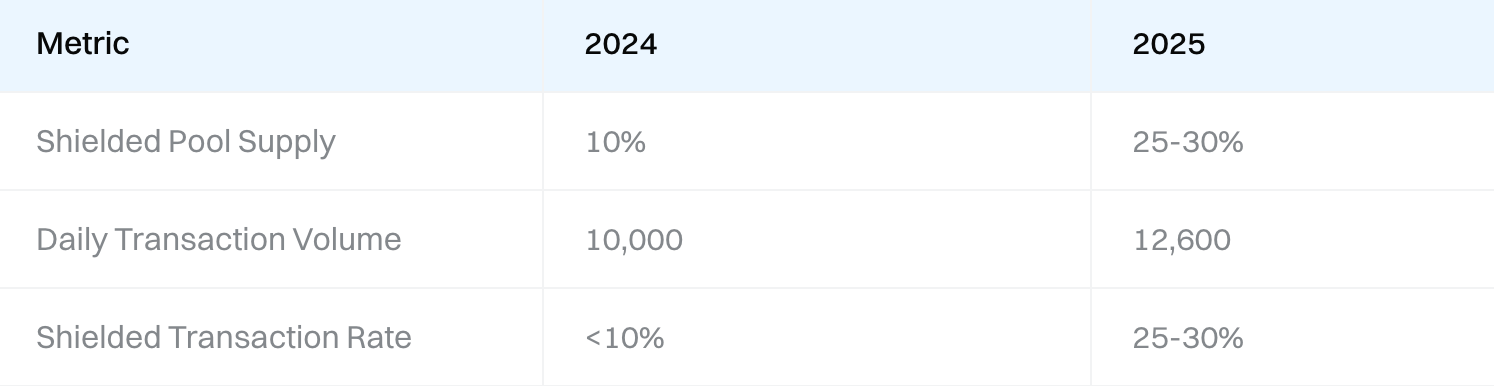
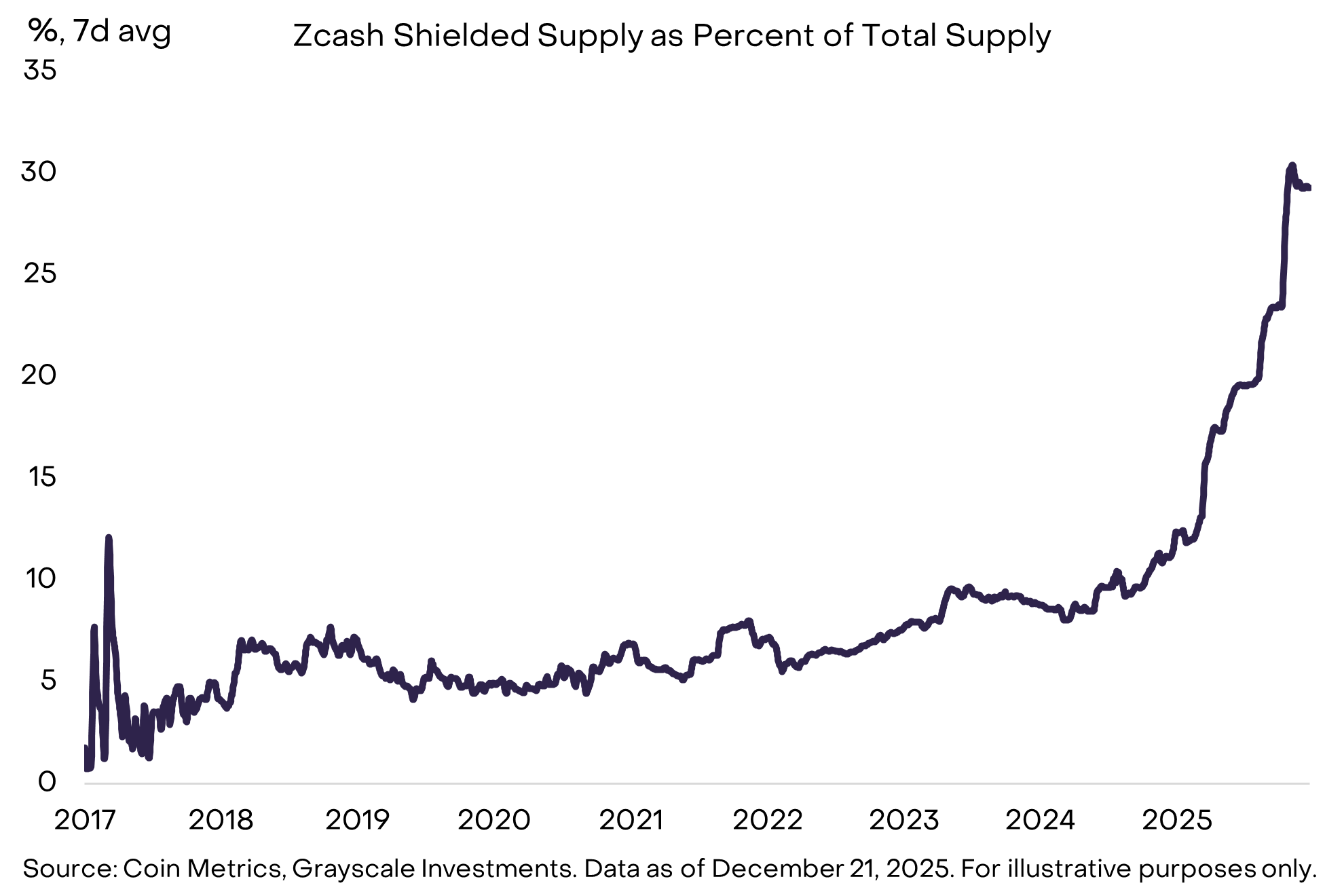
ZEC faces this with pragmatic tech and product moves. Its optional privacy model lets users choose transparent or shielded transfers, easing compliance concerns. Rising adoption of shielded transactions (on‑chain shielded volume growth metrics up to 25–30% of total ZEC activity in 2025–26) and expanding decentralized trading rails have helped sustain usage where centralized exchanges pulled back.
Growing demand for financial privacy remains one of the major factors that shape the price dynamics of ZEC. The rising concerns about data and on-chain transparency, as well as personal financial exposure, have been pushing users towards seeking safe coins for transactions. As per the on-chain analysis, the daily active addresses for privacy coins have shown a YoY increase of about 23% between 2024 and 2025, despite delisting and regulatory challenges
Zcash’s shielded transactions allow optional privacy, balancing confidentiality with compliance, making it more appealing for cautious investors. In 2025, usage of shielded transactions increased steadily, signaling that adoption is not just speculative hype but a response to real demand.
This trend suggests that privacy-conscious sectors could increasingly allocate capital to ZEC, supporting its long-term valuation.
By the way, did you know that private coins are not the only way to prevent wallet linking? ChangeNOW took care of this privacy demand – check out our recent release of Private Transfers feature.
Zcash continues to improve privacy and usability. In 2025, upgrades like NU6.1 enhanced shielded transactions, while wallet improvements (Zashi 2.0) added ephemeral addresses and better hardware wallet support. Planned 2026 developments include Ztarknet Layer‑2 rollups for private smart contracts and the Zebra node for faster, scalable, and secure transactions. These upgrades make shielded ZEC more practical, attracting both users and institutions.
4. Market Cycles
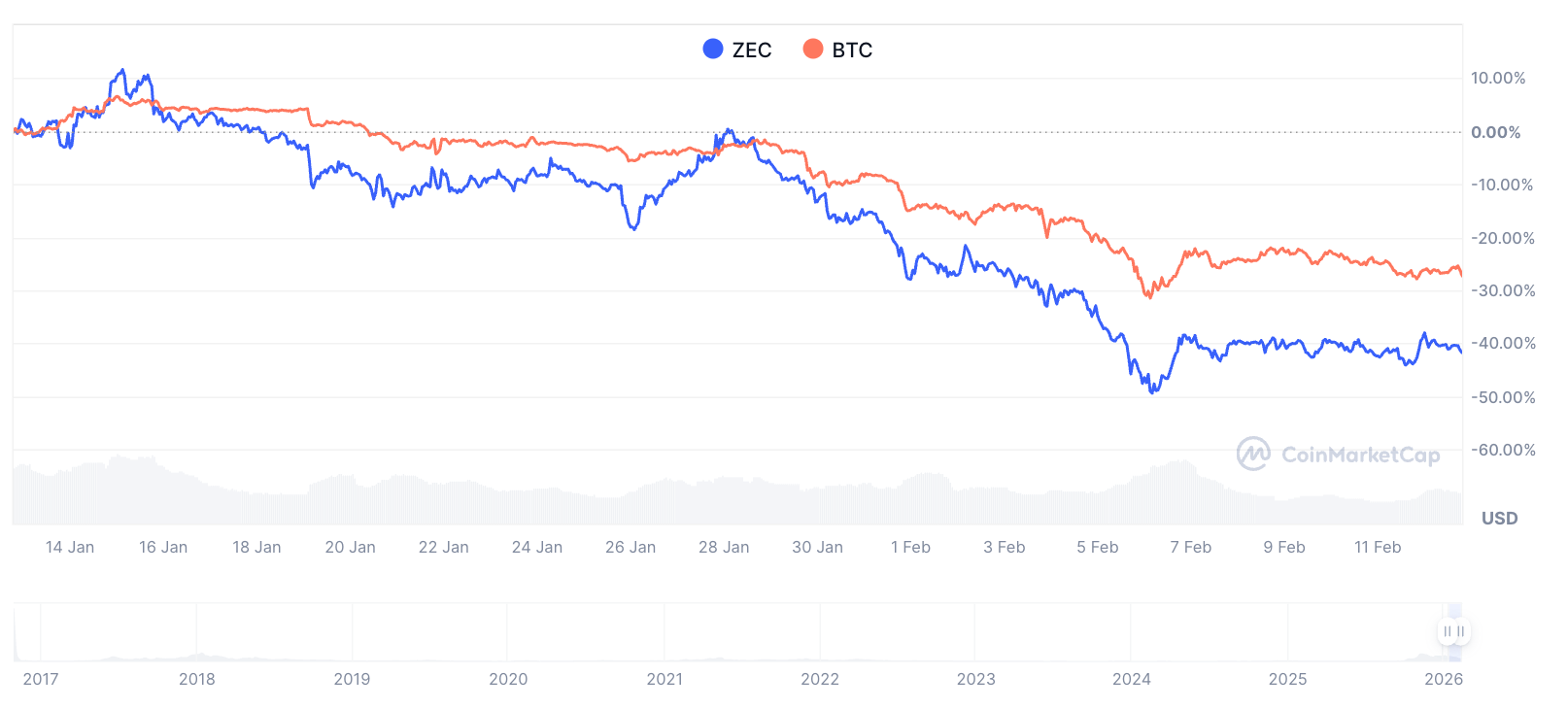
Zcash remains closely tied to Bitcoin and overall crypto market cycles. Historically, ZEC rallies and declines mirror BTC halvings and bull-bear swings, with altcoins often amplifying volatility. During 2025, ZEC’s price rose in early-year BTC rallies and dropped sharply in mid-year corrections, showing high sensitivity to macro liquidity. Even privacy narratives cannot override broader market sentiment: strong BTC bull markets lift ZEC, while bear phases reduce trading volume and adoption. Understanding these cycles is crucial for anticipating short-term volatility and long-term growth potential.
5. Governance Restructuring in 2026
In February 2026, Zcash underwent a structural shift as the founding development team officially split away from the Electric Coin Company (ECC) and established a new, independent entity called Zcash Open Development Lab (ZODL). This split came after a governance conflict between Bootstrap, the nonprofit organization that owns ECC.
Although the Zcash blockchain itself did not fork and the ZEC asset itself has not changed, the development team is no longer part of the ECC corporate structure. This sets up a two-center dynamic within the ecosystem.
On the one hand, the continued existence of the original development team could ensure that the technical vision and wallet infrastructure are stable. On the other hand, a lack of governance unity could create confusion about funding, roadmap alignment, and overall long-term coordination.
How investors respond to such structural changes may depend less on ownership and more on which team is ultimately responsible for innovation on the protocol level.
Zcash Risks Investors Shouldn’t Ignore
While Zcash offers strong confidentiality features and potential upside, investors need to be aware of real risks that could limit returns or impact adoption.
Regulatory challenges. Privacy coins are under intense regulatory focus. Governments may remove ZEC from prominent trading platforms, introduce KYC/AML regulations, or limit institutional investment. Even if they are not prohibited, regulatory uncertainty can cause sufficient volatility and illiquidity. 2025 showed this clearly: exchanges in Japan, South Korea, and parts of Europe restricted confidential coin trading, causing sudden price swings.
Competition. Zcash faces competition from Monero, Dash, and emerging anonymity-focused solutions. Although Zcash has optional shielded transactions, new cryptocurrencies with superior privacy-by-default protocols might gain popularity, potentially leaving Zcash with slower adoption rates in specific industries.
Adoption and Usage. The effectiveness of ZEC’s price thesis depends on users actively choosing privacy. Even with technological advancements, the usage rate of shielded transactions is lower than that of transparent transactions. If adoption rates slow down, ZEC may not reach its full market potential.
Market Volatility. Like all altcoins, ZEC is tied to Bitcoin and overall crypto cycles. Even if the anonymity narrative is strong, macro liquidity events or BTC bear markets can sharply reduce ZEC’s price and trading volume.
Zcash is not a speculative meme coin; its upside depends on real adoption, technological improvements, and regulatory navigation. Ignoring these risks could expose investors to significant surprises. Balancing conviction with caution is key for anyone considering ZEC as part of a diversified crypto portfolio.
Is ZEC a Good Investment?
Zcash is not a safe bet. It’s a conviction play. If you think financial security will matter more over the next decade, then ZEC is a good addition to your portfolio.
If you think regulation will suffocate these coins completely, then your money might be better spent elsewhere. The potential is there, the risk is there too.
Always remember to do your own research before entering the crypto market.
At the end of 2026, ZEC is likely to be trading between $160 and $250 in a pessimistic outlook, between $300 and $450 in a base case scenario, and between $600 and $900 in an optimistic outlook.
In 2027, ZEC is likely to be trading between $90 and $150 in a pessimistic outlook, between $180 and $280 in a base case scenario, and between $400 and $650 in a strong upside trend.
By 2030, ZEC is likely to be trading between $60 and $120 in a downside scenario, between $500 and $800 in a base case projection, and between $2,000 and $3,500 in a high growth projection.
For 2035, projections indicate a possible range of $70 to $150 in a conservative scenario, $500 to $900 in a moderate scenario, and $3,000 to $6,000 in an aggressive growth scenario.
Even in a strong bull market, reaching extreme highs is considered ambitious but possible.
According to the current long-term forecast until 2035, it is highly unlikely that ZEC will reach $10,000, even in the best-case bull market scenario, which may not exceed $6,000. Such a price would require unprecedented adoption and market conditions well beyond current forecasts.
Zcash has optional shielded transactions that conceal the details of the transaction with the help of zero-knowledge proofs. Bitcoin transactions are transparent on the blockchain. Read more about crypto traceability in our article.
It is possible for governments to ban the listing of a cryptocurrency, but it is hard to ban the network itself. Availability can be restricted, though.
Yes. Zcash operates on a proof-of-work model similar to Bitcoin, though its emission schedule differs.
They have different approaches to privacy. Monero has it enforced by default. Zcash has optional confidential transactions with selective disclosure capabilities. In our previous articles we compared these two coins – read the guide to learn more: Monero vs. Zcash comparison.
It could happen in a strong macro bull market and with more demand for private transactions.
Best Monero Wallets: How to Choose the Right XMR Wallet
Choosing a Monero wallet isn’t just about convenience. In this guide, we break down the best Monero wallets and explain how to pick a secure XMR wallet that fits your needs.
Ethereum’s network activity is hitting ATHs, yet its token price recently collapsed to a multi-year low. Is this a temporary market shakeout ahead of the next major upgrade, or is ETH's economic model fundamentally broken?